Fast 3D image generation for healthy brain aging using diffeomorphic registration
Published in Human Brain Mapping (2023).
Work by Jingru Fu, Antonios Tzortzakakis, José Barroso, Eric Westman, Daniel Ferreira, and Rodrigo Moreno. Basis for the later Synthetic Healthy Brain Aging dataset.
Abstract
Analysing and predicting brain aging is essential for early prognosis and accurate diagnosis of cognitive diseases. The technique of neuroimaging, such as Magnetic Resonance Imaging (MRI), provides a non-invasive means of observing the aging process within the brain. With longitudinal image-data collection, data-intensive artificial intelligence (AI) algorithms have been used to examine brain aging. However, existing state-of-the-art algorithms tend to be restricted to group-level predictions and suffer from unreal predictions.
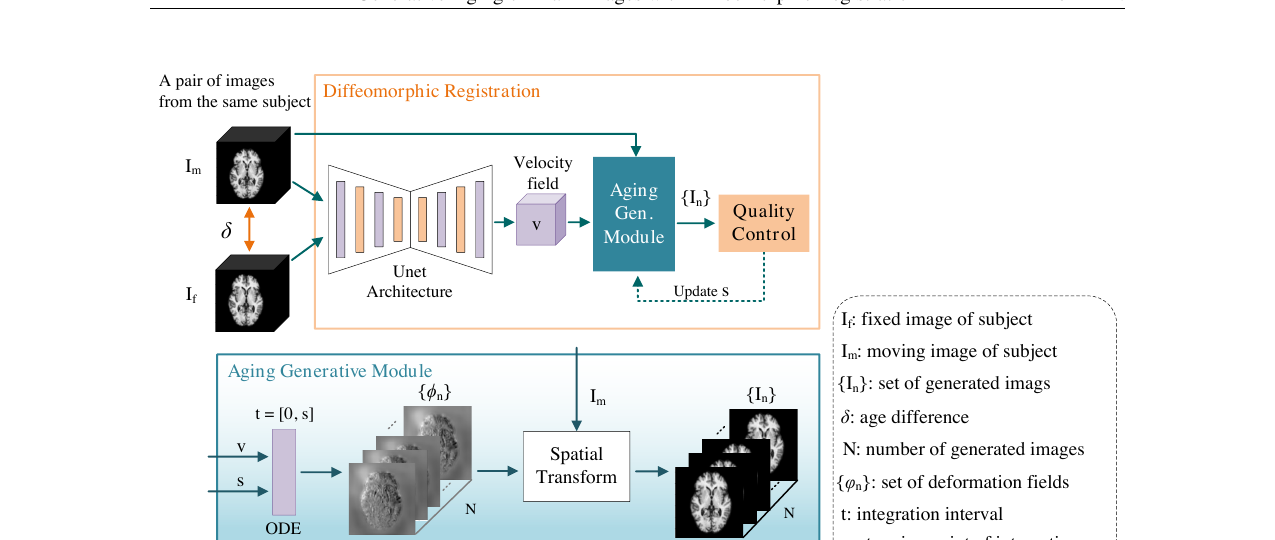
This paper proposes a methodology for generating longitudinal MRI scans that capture subject-specific neurodegeneration and retain anatomical plausibility in aging. The proposed methodology is developed within the framework of diffeomorphic registration and relies on three key technological advances to generate subject-level anatomically plausible predictions:
- A computationally efficient and individualised generative framework based on registration.
- An aging generative module based on biological linear aging progression.
- A quality-control module to fit registration for the generation task.
The methodology was evaluated on 2,662 T1-weighted MRI scans from 796 participants from three different cohorts. The synthetic images were assessed using six commonly used quantitative criteria and a qualitative assessment by a neuroradiologist. Overall, the experiments show that the proposed method can produce anatomically plausible predictions that can be used to enhance longitudinal datasets, in turn enabling data-hungry AI-driven healthcare tools.
- Paper: doi:10.1002/hbm.26165
- Preprint: arXiv:2205.15607
- Code: minnelab/Synthetic-Brain-Aging
- Dataset: AIDA Data Hub